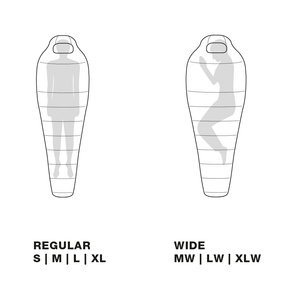

Product Description

Season
Shape
Packed Volume
M: 19.1 l
MW: 22.2 l
L: 22.2 l
LW: 23.4 l
Delivery contents
Compression bag
Color Inside
Zipper variant
Shell Fabric
Liner
DWR free
Fill
Climate protection with myclimate
Since 2021, EXPED has been supporting certified myclimate climate protection projects through a financial contribution. Together with the nonprofit organization, we have calculated the carbon footprint of all our products and our operations at our Zurich location. Our annual contribution is based on this calculation - but it does not change the carbon footprint itself.
Recycled materials
This product contains recycled materials. You can find the exact composition in the material description.
bluepass article
Bluesign® is an independent system that has worked with the textile industry for over 25 years to help make production safer for people and the planet. Bluepass is its certification mark.
Oeko-tex certified material
Oeko-Tex® is a testing and Certification system for raw materials and finished products. All materials of this product which are accordingly labelled are tested and certified according to the Oeko-Tex® standard.
Our sleeping bags are tested by certified laboratories in a climate chamber using a standardised manikin in accordance with ISO 23537-1. The standard specifies test procedures and thermal requirements for adult sleeping bags to ensure they are comparable. This provides a clear basis for customers to choose the sleeping bag that best meets their specific needs. The three most common ratings are the Comfort, Limit and Extreme temperature ranges. The test reports for our sleeping bags are available on the EXPED website.
- Comfort: the temperature at which a person who is sensitive to cold can expect a restful sleep in a relaxed position.
- Limit: the temperature at which a person who is not very sensitive to cold can sleep comfortably.
- Extreme: Temperature range in which short-term survival is possible but there is a considerable risk of hypothermia (risk/survival range, risk of damage to health)
It is best to store the sleeping bag in the mesh storage bag provided. This will ensure that the insulation retains its maximum bulk and thermal performance. When traveling, it is okay to compress the sleeping bag and carry it in the included stuff sack.
When you return from a trip, it is very important to let your sleeping bag dry completely. Then store it in the mesh storage bag in a dry and temperature controlled place.
If you wash your sleeping bag too often, the insulation can suffer (down or synthetic). The insulating power may decrease. We recommend cleaning the sleeping bag with a damp sponge. If the sleeping bag needs a more thorough cleaning, use only a front-loading machine (no agitator!) and a special detergent from Nikwax or McNett.
Before you put the bag in the washing machine, close the zipper. Use a cold water and gentle wash cycle, and after the wash cycle is complete, run a second rinse cycle without detergent. This will ensure that all detergent residue is removed. Two spin cycles will help get a lot of moisture out of the sleeping bag.
It is best to hang the sleeping bag afterwards and air dry it. Keep massaging the sleeping bag the down tufts apart. Depending on the humidity, it may take several days to dry completely. If you need to dry it faster, use a tumble dryer on low heat (often there are special down drying programs). To loosen up the down in the dryer, you can put some tennis balls in the dryer with it.